PMO software built around evidence, not reporting overhead.
A PMO should not have to rebuild every project’s reality in a spreadsheet each month before it can say anything about the portfolio. Flowr keeps the operational project record and the reporting model in the same system, so the portfolio view is assembled from projects rather than collected from people.
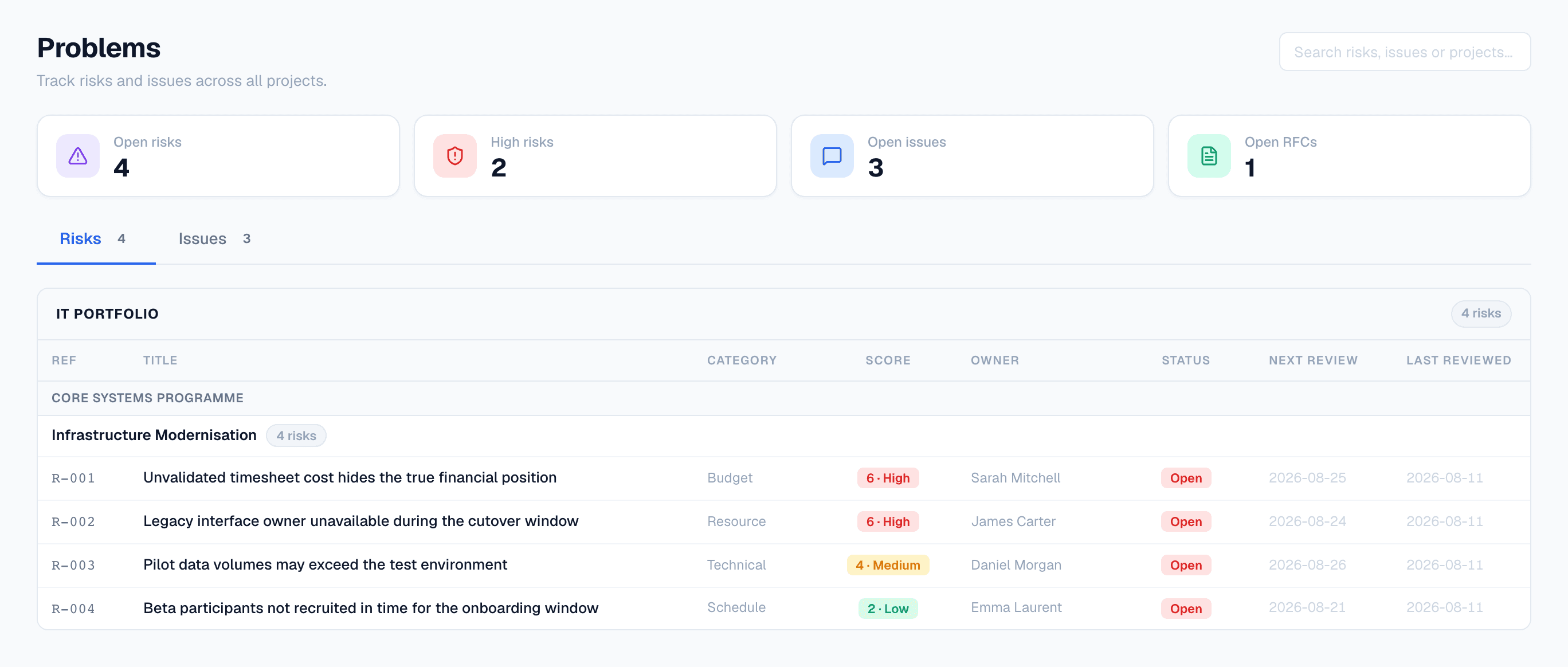
The portfolio deck is a second version of the truth, maintained by hand.
Most PMOs are not short of information. They are short of information that agrees with itself, because it arrives as thirty separate accounts written to thirty separate deadlines.
- Each project plans in its own file, with its own idea of what a phase is.
- Status is collected by template — chased, late, and already a fortnight old when it lands.
- RAG is assigned project by project, so amber means one thing here and another thing there, and the portfolio cannot be sorted by it.
- Tolerance is interpreted rather than applied, because it was never written down as a number.
- Financials are transcribed into the deck, so the portfolio position is as fresh as the last time someone had an afternoon.
The work is real and it is skilled. It is also assembly, and it is what the PMO does instead of assurance.
Delivery and reporting on the same record.
Projects are run in Flowr — plan, baseline, timesheets, budget, risks, issues, milestones — so the reporting layer has something to read. That is the structural difference from a portfolio tool that sits above delivery: there is no collection step, because the portfolio is looking at the projects themselves.
It also means a project cannot be current in the portfolio and stale in reality. The two are the same object.
Set control once, for the organisation.
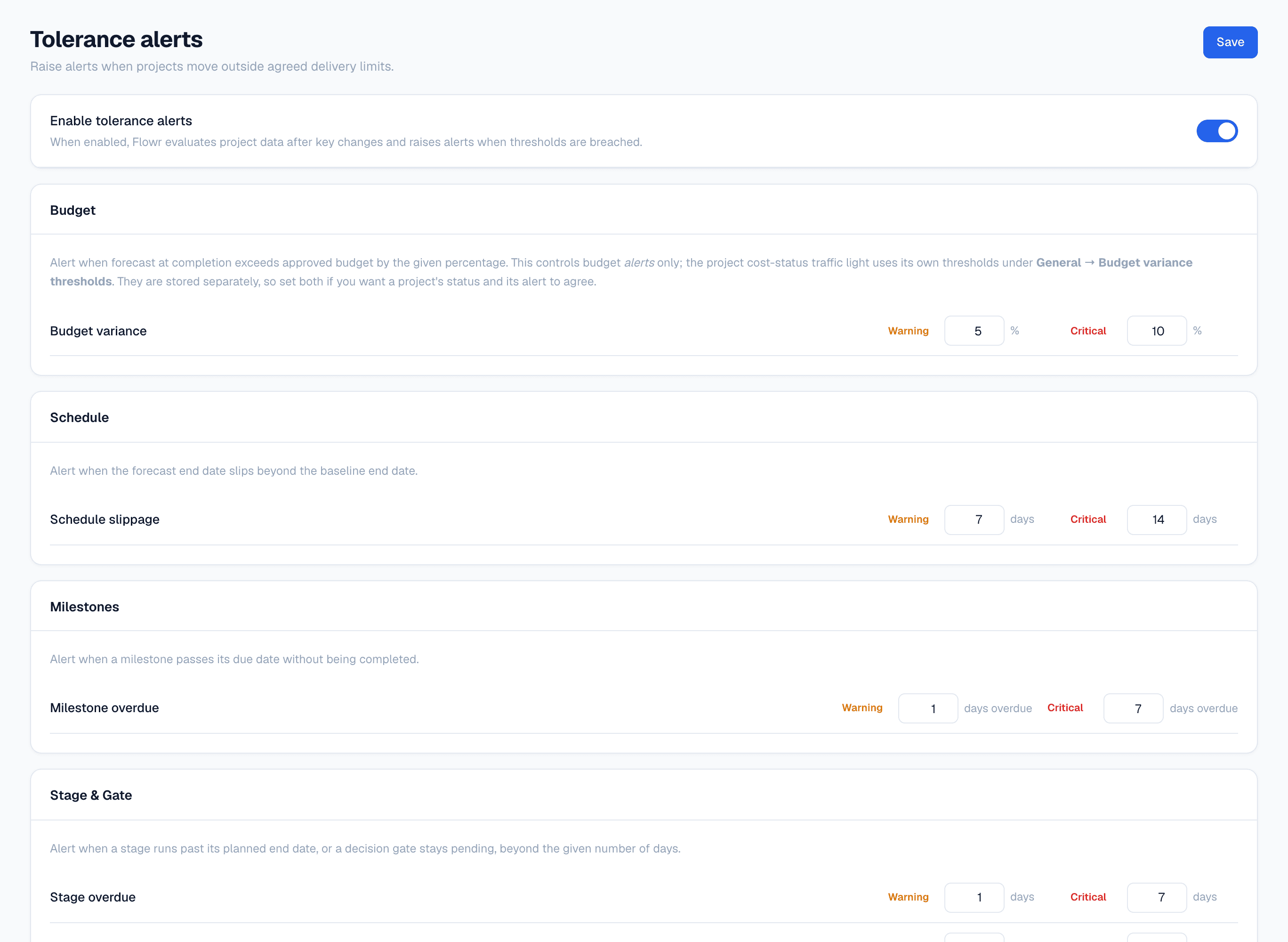
Tolerances, lifecycle stages, gates and roles are organisation-level decisions in Flowr rather than per-project habits. That is what makes a portfolio comparable: two projects reported amber are amber for the same reason.
Stages and gates from a template
Delivery splits into controlled stages with approval points taken from an organisation template, so a phase means the same thing in every project.
Roles the governance model already names
Fifteen PRINCE2 and PMI roles ship ready to assign, from Executive and Senior Supplier to Project Assurance. Add your own where your organisation names them differently.
Business case kept, not overwritten
The rationale and expected benefits are snapshotted at approval, so the closure review has something to review and lessons go to a library the next project can read.
An audit history per project
Who changed what, on the project record. Organisation-wide audit search and its filtered export are separate, for the plans that need them.
The same evidence, rolled up.
Not a second reporting process that drifts from the first. Each project’s monthly status report is assembled from its own live data and signed by its project manager; the portfolio reads those reports rather than a re-keyed summary of them.
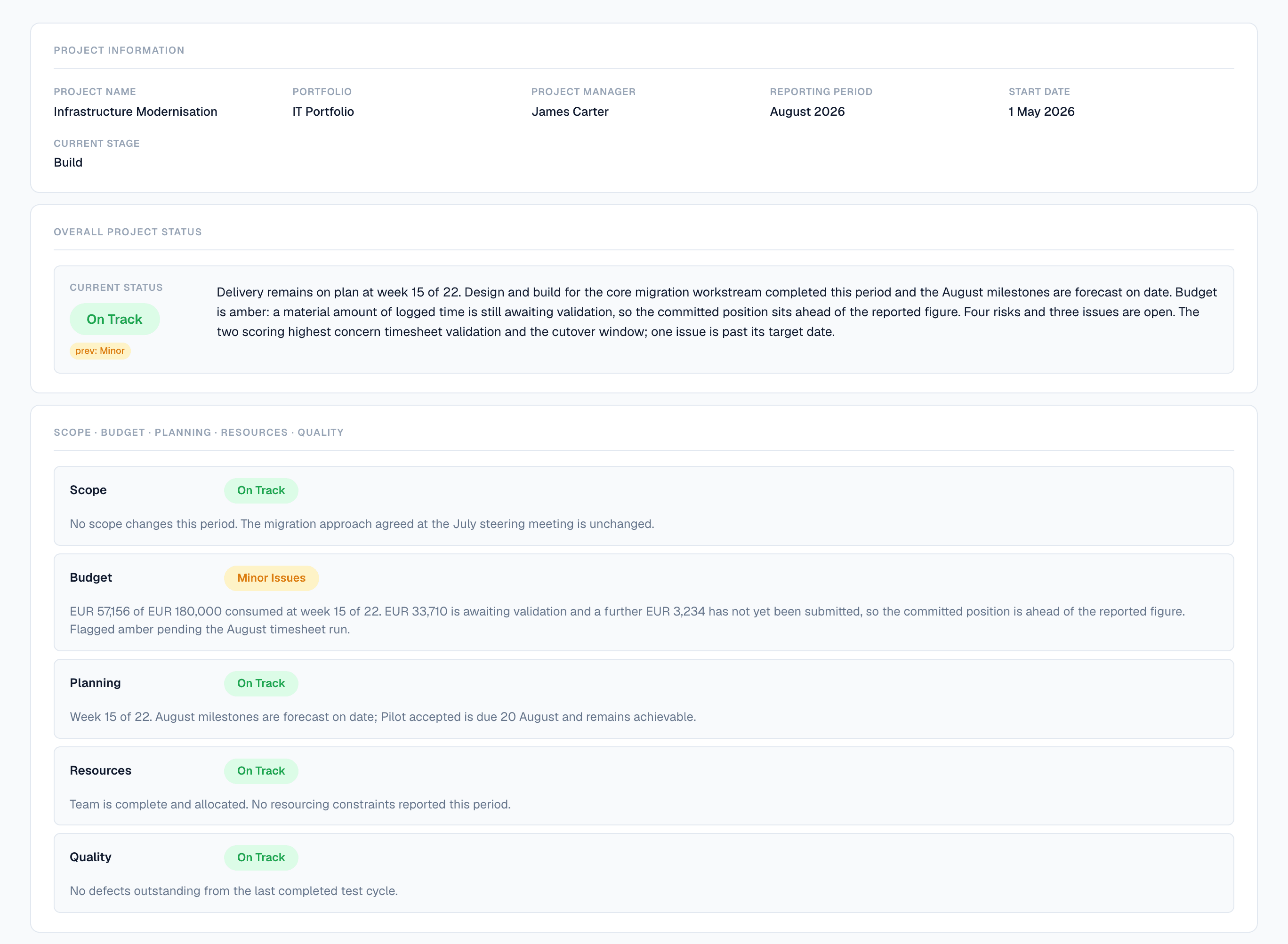
Scope, Budget, Planning, Resources and Quality are rated on their own, so one amber does not disappear inside an overall green.
Reporting periods open, close and can be reopened — and the reopening is recorded. A closed period is frozen.
Export to a print-ready A4 PDF with the RAG colours intact, for the board pack that still has to be a document.
One project view becomes one portfolio view.
Portfolios and programmes model delivery above the individual project, and the roll-ups read from live project data: budget and forecast, every project on one timeline, and the milestones that are late, next or critical across projects.

Cross-project milestones
What is late, next and critical across the portfolio, with the project and programme each milestone belongs to.
Resource capacity
Where workload is building, with approved leave and organisation holidays already removed from availability.
Budget roll-up
Portfolio and programme totals computed from live project figures. A portfolio spanning several currencies is reported one currency at a time — Flowr does not convert between them.
A dashboard that knows the reader
Administrators see the organisation, portfolio managers their portfolio, project managers their projects. A role behaviour rather than a plan boundary.
Start the month with the projects that need you.
The organisation-wide control centre applies your tolerances across every project and surfaces what has crossed them, with the evidence attached. The point is not that the PMO stops reading projects — it is that it stops reading all of them equally in order to find the three that matter.
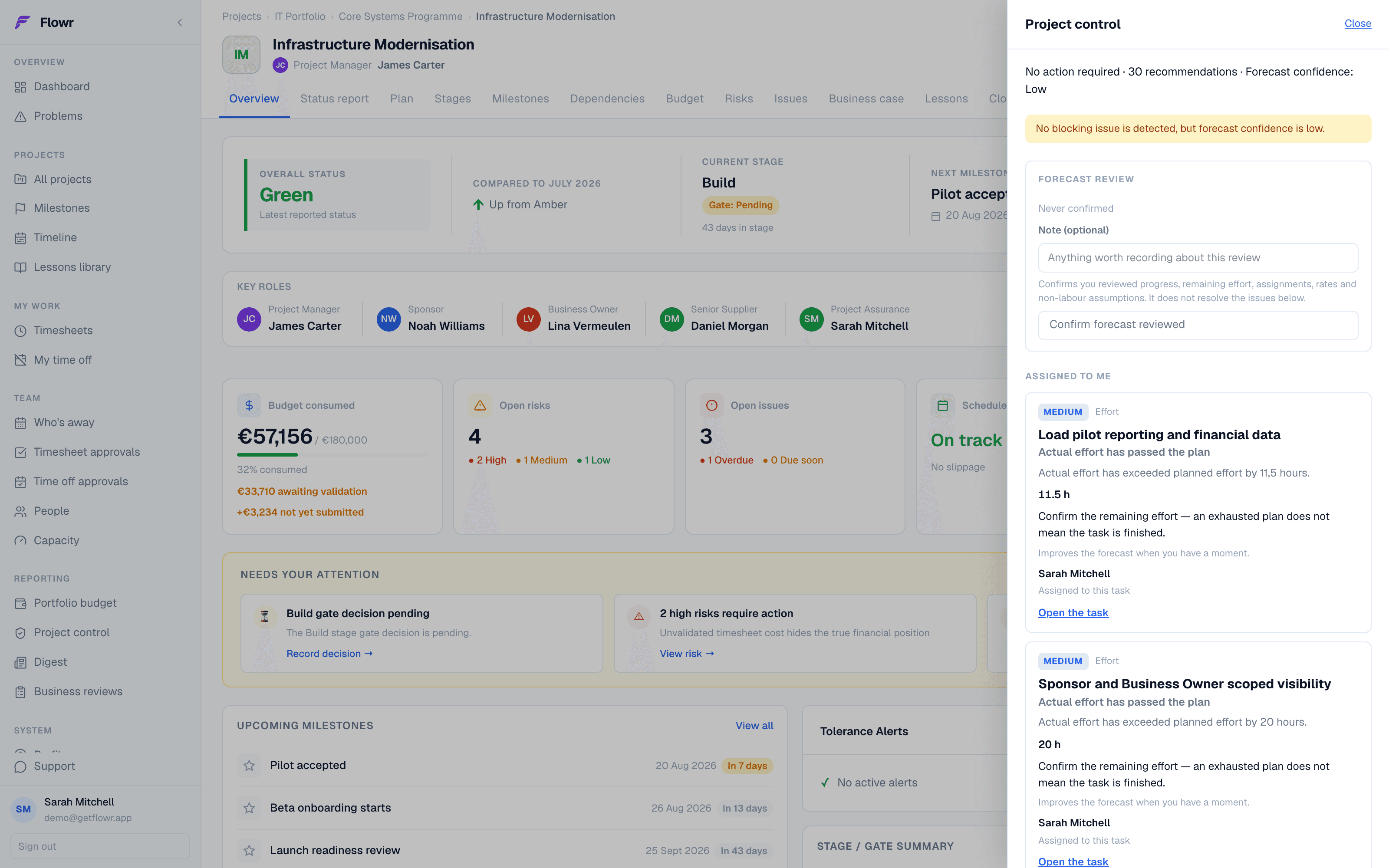
None of this decides anything. A finding can be acknowledged with a recorded reason, assigned to a person, or cleared — and the judgement, with its justification, stays on the record where the next review can read it.
A review that is a version of record.
Business reviews are assembled from the portfolio and published. Once published a review is the version of record, and only one can be published at a time — a constraint the database enforces rather than a convention the PMO maintains. The previous ones stay readable, so a quarterly conversation can refer back to what was actually said in July rather than to what July looks like now.
Bring one portfolio, and see what it looks like assembled.
Early access is granted one workspace at a time so we can set Flowr up against your real projects, your tolerances and your reporting calendar. Your 14-day trial begins only when you move onto a plan, so evaluating Flowr never spends it.